
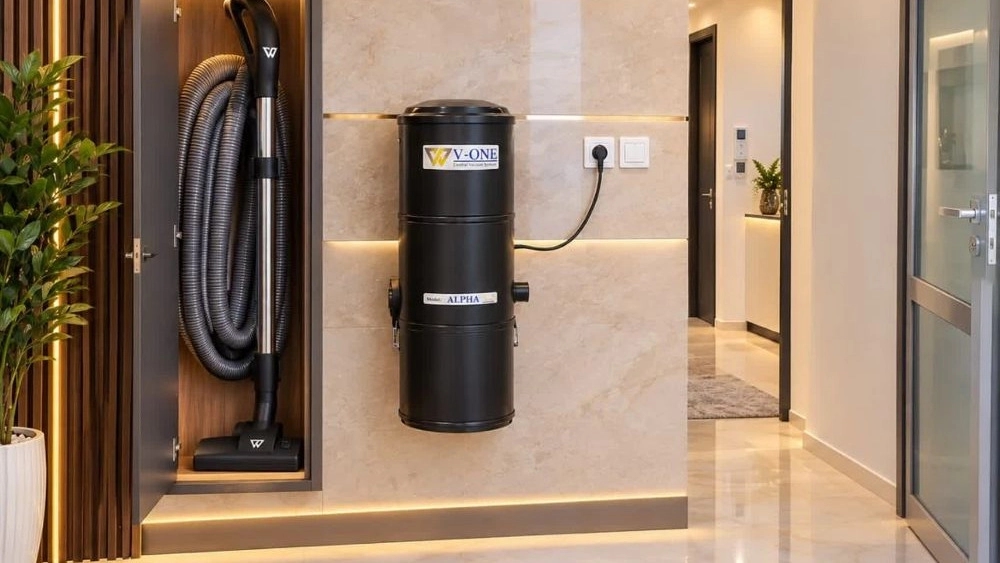
With the increase of modern constructions and more attention to the quality of life in residential, office and commercial buildings, the use of smart and functional equipment for cleaning the environment has become very important. One of the systems that can significantly change the daily cleaning experience is the central vacuum cleaner. The implementation of a central vacuum cleaner in Tehran has attracted the attention of many builders, architects and owners due to the expansion of apartment living, the construction of residential complexes and the increasing desire to use advanced construction equipment.
The central vacuum cleaner is a system in which the engine and the main tank are installed in a certain place of the building and will be connected to the suction sockets in different parts of the building through a network of special pipes. In this method, instead of moving a regular vacuum cleaner, the user only connects the suction hose to a special outlet and cleans the desired space.
The implementation of a central vacuum cleaner in Tehran requires a detailed examination of the building plan, selection of suitable equipment, design of the piping route and basic installation of various system components. If these steps are done correctly, the system can perform well in the long run and make cleaning the environment easier.
Vivan production, focusing on the introduction of practical solutions in the field of construction equipment and systems, can be considered as one of the considered options for people who seek to better understand the required equipment and choose the right solution for their project. In this article, we examine the installation steps, factors affecting the cost, important technical points and the benefits of using a central vacuum cleaner.
What is a central vacuum cleaner and how does it work?
The central vacuum cleaner is a type of fixed cleaning system that, unlike ordinary vacuum cleaners, all its main components are placed in a certain point of the building. This system usually includes a vacuum motor, a dust collection tank, a filter, a piping network, suction sockets and a special hose.
During use, the hose is connected to one of the suction sockets. Then the central motor is activated and by creating air flow, it directs the dust and pollution through the pipes towards the main tank. The location of the engine installation is usually chosen in such a way that it is easy to access for servicing and emptying the tank, and the sound of the device causes the least disturbance to the residents.
In construction projects, the implementation of a central vacuum cleaner in Tehran should be designed according to the dimensions of the building, the number of floors, the size of the spaces and the location of the rooms. Choosing the right engine capacity and determining the correct piping route has a direct effect on the final performance of the system.
This equipment can be used in new buildings, villas, large apartment units, offices and some commercial spaces. Of course, the type of device and the design of the piping network should be chosen according to the intended application.
Why is it important to implement a central vacuum cleaner in Tehran?
Tehran, as one of the large and densely populated cities of the country, faces diverse conditions in terms of the architecture of buildings and the way of life of its residents. In many new buildings, optimal use of space, increasing comfort and reducing problems caused by traditional equipment have become one of the design priorities.
Executing a central vacuum cleaner in Tehran can be a practical solution for buildings that have a large area or include several rooms and floors. In this system, the user does not need to move the main device from one room to another or from one floor to another.
On the other hand, placing the engine in a fixed place makes its sound less noticeable in the main living space. This issue is significant for families who care about the peace of the environment or need cleaning at different times of the day.
Also, in buildings under construction, it is possible to predict the route of pipes and the location of suction outlets from the beginning. This issue helps to run the system more regularly and prevent unnecessary destruction in the next steps.
Advantages of using a central vacuum cleaner
Reducing the sound of the device in the living space
One of the important advantages of the central vacuum cleaner is the placement of the motor in a place away from the main rooms. In conventional vacuum cleaners, the motor is located next to the user and the sound of the device can be heard directly in the cleaning space. But in the central system, if the installation location and the design path are chosen correctly, the engine noise will be less in the interior of the building.
Of course, the amount of noise reduction depends on the type of engine, the quality of installation, the insulation of the device and the conditions of the building.
Ease of environmental cleaning
In conventional systems, the user has to move the body of the device, watch out for its collision with furniture, and manage the power cable in different directions. On the other hand, the central vacuum cleaner provides the possibility of cleaning using a special hose and suction sockets.
This feature is especially useful in large homes, long corridors, multi-story buildings and environments with a large number of devices.
Reducing the need to move equipment
In a central vacuum cleaner, the motor and the tank are located in a certain place, and only the hose and the suction line are moved in the interior. This structure can simplify the cleaning work and reduce the need to carry the device continuously on the stairs.
The possibility of designing according to the building
One of the important features of this system is the ability to design the suction network based on the building plan. The location of the sockets, the route of the pipes and the installation location of the device can be determined according to the needs of the project.
For this reason, the implementation of a central vacuum cleaner in Tehran, in the case of a basic design, allows the proper use of the system in buildings with different plans.
Help with dust management
In this system, the dust is transferred to the central tank through the piping network. If you choose the right device and use standard filters, managing the collected pollution can be easier.
However, the performance of the system in the field of controlling suspended particles depends on the type of filter, the design of the device, the method of discharge and the condition of the air outlet. Therefore, without checking the technical specifications, any central vacuum system should not be considered completely free of particle emissions.
The steps of implementing a central vacuum cleaner in Tehran
The correct implementation of this system depends on a set of technical steps. Observing the order of the steps will prevent rework, additional destruction and possible problems in the system's performance.
First step: checking the plan and conditions of the building
In the first step, the architectural plan of the building is checked. The number of rooms, corridors, floors, the area of the spaces and the location of different parts should be known.
Also, it is necessary to check the condition of walls, false ceilings, installation ducts and the passage of other construction equipment. The goal is to design the piping route of the central vacuum cleaner without interfering with other facilities.
In the buildings under construction, coordination with the facility engineer and the project manager is very important. In ready-made buildings, the possibility of running pipes without extensive destruction should also be evaluated.
The second step: determining the installation location of the engine and tank
The installation location of the central motor must be chosen carefully. Based on the design of the building, this place can be considered as a parking lot, warehouse, facility space or a suitable part of the building.
The chosen location should have enough space to install the device, empty the tank, change the filter and perform periodic services. Proper access to electricity and the possibility of providing the required ventilation of the device is also necessary.
In addition, attention should be paid to the control of sound transmission and vibration. Installing the device on an inappropriate surface or in a space without sufficient ventilation may affect the performance of the system.
The third step: designing the piping route
Pipe laying is one of the most important parts of running a central vacuum cleaner in Tehran. The path of the pipes should be designed in such a way that air and impurities move towards the engine with unnecessary resistance.
In route design, the length of pipes, the number of joints, the number of knees and the location of branches are important. Long and complicated paths may increase pressure drop and reduce suction performance.
It is also necessary to use pipes and connections compatible with the central system. Piping should be done according to the equipment manufacturer's instructions and avoid using inappropriate parts or non-standard connections.
The fourth step: determining the location of the suction sockets
The suction outlets should be placed in positions that provide adequate coverage for the intended space. Its purpose is that the user can clean a major part of the space of each floor with the appropriate length of the hose.
In determining the location of outlets, the distance from fixed furniture, room corners, doorways and corridors is important. The number of sockets should also be chosen according to the size, shape of the plan and the length of the hose.
If the location of the sockets is determined without careful examination of the map, some parts of the building may not be covered well or the user may have to use a hose of inappropriate length to clean different parts.
The fifth step: implementing pipes and installing sockets
After the design is completed, the pipes are installed in the predicted routes. At this stage, the connections should be made firmly and properly to reduce the possibility of air leakage and separation of parts.
Also, pipes should be protected against possible pressures caused by construction operations. The entry of materials, plaster, cement and other pollution into the pipes can cause problems in the system setup.
At the time of installing the sockets, attention should be paid to the appropriate height, connection strength and coordination with the final wall covering.
The sixth step: installing the engine and main equipment
After the piping network is prepared, the central motor, tank and filters are installed. At this stage, the specifications of the device must be in harmony with the initial design.
Suction capacity, engine power, serviceability, filtration type, and compatibility of the device with the length of the piping network are among the important things in choosing the equipment.
Electrical installation of the device must also be done according to safety requirements and manufacturer's instructions. Compliance with the principles of electrical connection, proper protection and safe access for maintenance is very important.
Seventh step: testing and setting up the system
At the end of the implementation of the central vacuum cleaner in Tehran, it is necessary to test all parts of the system. The operation of the motor, the suction in the sockets, the condition of the connections and the correct operation of the keys or the control system should be checked.
If there is an air leak, pipe blockage or problem in the connections, the problem must be solved before the final delivery.
Also, it is better to explain to the owner or user how to use the system, how to empty the tank, how to check the filter and maintenance tips. This training helps to maintain the proper functioning of the device over time.
Factors affecting the cost of running a central vacuum cleaner in Tehran
The cost of running a central vacuum cleaner in Tehran depends on several factors, and it is not possible to consider the same operating conditions for all buildings. The type of building, the condition of the facilities, the equipment selected and the amount of operation required, all affect the final cost.
The size and number of floors of the building
The wider the building space, the design of the piping network and the coverage of different points will need more consideration. In multi-storied buildings, vertical paths, where pipes pass and how to connect different parts become more important.
Type and quality of equipment
Central engine, filter, tank, sockets, pipes and connections are the main components of the system. Construction quality, durability, serviceability, and equipment capacity compatibility with the building can affect the overall cost of the project.
Choosing equipment based solely on appearance or advertised specifications is not recommended. Examining technical information, warranty conditions and access to replacement parts makes decision making more accurate.
Building condition and construction stage
Executing the system in a new building usually allows better planning for the passage of pipes. In this situation, the paths can be executed before the completion of the walls and ceilings.
In contrast, the implementation of central vacuuming in ready-made buildings may require opening parts of the wall or ceiling, passing the pipes through limited routes and performing repair operations. This issue can increase the complexity of project implementation.
The complexity of the piping network
The number of branches, the length of the routes, the number of sockets and architectural limitations are important factors in determining the volume of executive operations. A simple and principled design can prevent the unnecessary increase in the number of connections.
In this context, checking the map before starting work is very important; Because it will usually be more difficult to correct plumbing mistakes after the joinery is completed.
Installation and support services
In addition to equipment, installation quality, final testing and post-implementation services should also be included in the project evaluation. Choosing a contractor based solely on initial cost may lead to neglecting component quality, technical principles, and maintenance needs.
In order to make the right choice, it is better to clearly check the equipment specifications, scope of installation services, warranty conditions and executive responsibilities.
Important points before running a central vacuum cleaner
Choosing the right engine capacity
One of the common mistakes in the design of central suction systems is choosing a motor without considering the actual specifications of the building. The capacity of the motor must be in harmony with the length of piping, the number of sockets, the amount of use and the pressure drop of the network.
A weak motor may not provide the required suction, and choosing a device with a disproportionate capacity can also cause an unnecessary increase in energy consumption or maintenance costs.
Therefore, the selection of equipment should be based on technical calculations and manufacturer's specifications.
Use of appropriate pipes and connections
Central vacuum piping is not the same as normal building piping. The components of the system must be suitable in terms of dimensions, resistance, type of connection and compatibility with the suction flow.
Using mismatched parts may increase the possibility of clogging, leakage or performance loss. Also, unnecessary twists and turns should be avoided in designing the route.
Paying attention to the location of exhaust air
Depending on the type of device and system design, the exhaust air may be directed to a specific location. Therefore, the manufacturer's instructions about air evacuation, ventilation and distance from the windows or air intakes of the building should be followed.
Improper design of the outlet can cause pollution to return or cause disturbance in the environment.
Predict access for maintenance
The central system, like other mechanical equipment, needs periodic service. The tank should be drained at the appropriate time, the filters should be checked and the piping routes should be evaluated in terms of performance.
For this reason, the installation location of the device should not be in such a way that it becomes difficult to access the engine, tank or consumable parts.
Coordination with other building facilities
In modern buildings, the interior space of walls, ceilings and ducts is usually the passage of several types of facilities. The implementation of a central vacuum cleaner in Tehran should be coordinated with the route of electric cables, water pipes, ventilation channels and other equipment.
This coordination prevents the interference of facilities and creating implementation problems in the next steps.
Selection of an experienced performer
Executive experience and familiarity with the technical specifications of the system is very important. The right contractor should be able to design the piping route, suggest the appropriate equipment for the project and test the performance of the system after installation.
Examining portfolios, knowing the terms of the warranty and receiving technical explanations about how to implement it can help you make a more confident choice.
Implementation of central vacuum cleaner in new and old buildings
New buildings
Newly built buildings have suitable conditions for running a central vacuum cleaner; Because the path of the pipes can be determined at the right time and before the final completion of the walls and ceilings.
In these buildings, the best approach is to start the system design from the initial stages of the facility. In this way, the location of the sockets, horizontal and vertical paths and the engine location will be coordinated with the architectural plan.
This method helps to reduce destruction, run more regularly and have better access to different parts of the system.
Old and ready buildings
In old buildings, it may also be possible to implement a central vacuum cleaner, but the project conditions must be checked individually. The limitation of the passage space of the pipes, the material of the walls, the condition of the roofs and the location of the existing facilities can affect the execution method.
In such buildings, the use of accessible paths, false ceiling or existing facility spaces can help reduce destruction if the conditions are suitable.
However, before making a decision, the possibility of technical implementation of the system and the amount of required changes should be evaluated.
Vivaan's production role in choosing the right equipment and solutions
Choosing the right equipment is one of the most important steps in running a central vacuum cleaner in Tehran. The quality of parts, coordination of components and attention to the real needs of the building have a direct effect on the final result of the project.
Vivaan production can be mentioned in the framework of activities related to the production and introduction of products, as a name for examining and recognizing the solutions needed for construction projects. However, to choose any product or set of services, it is necessary to check the actual technical specifications, scope of activity, quality of construction and support conditions independently.
When evaluating Vivaan production for a construction project, it is important to pay attention to several issues:
- Detailed examination of the type of products and equipment that can be provided according to the needs of the project.
- Receiving technical information about the type of parts, the compatibility of the components and the conditions of use.
- Ensuring the existence of the installation and maintenance manual for the selected equipment.
- Checking the warranty conditions and how to supply the required parts in the future.
- Comparing the quality of the products and their compatibility with the building specifications.
- Coordination between the selected equipment and the design of the piping network. central.
Attention to these matters makes the selection of equipment based on the real needs of the building instead of relying on mere advertisements. In projects where durability, proper performance and ease of maintenance are important, it is necessary to carefully check the product specifications and the quality of its implementation.
Proper maintenance of the central vacuum cleaner
If there is a noticeable reduction in suction, it is necessary to check the condition of the hose, sockets and piping. Obstruction, air leakage or problems in the filter can be possible reasons for reduced performance.
Also, it is better to perform technical services in the recommended intervals. Checking the health of connections, engine performance and the condition of electrical components can help identify problems early.
In the implementation of a central vacuum cleaner in Tehran, it is important to pay attention to maintenance from the time of design; Because choosing the right place for the engine and predicting access to parts makes the service process easier.
How to make the best decision to implement a central vacuum cleaner?
To choose the right solution, the needs of the building must be determined first. The number of floors, size, number of rooms, usage and architectural conditions are decisive factors. After that, the design of the piping network and the location of the sockets should be done based on the real plan.
In the next step, the technical specifications of the engine and other components are checked. It is better to choose the equipment by considering the quality of construction, repairability, access to parts and warranty conditions.
Also, it is necessary to know the range of executive services before starting the implementation. Design, equipment supply, installation, final testing and maintenance training should be clearly defined so that there is no ambiguity about responsibilities at the end of the project.
Checking the contractor's ability to implement similar projects and paying attention to the quality of installation details are also measures that can reduce the possibility of future problems.
Vivaan production can also be evaluated as one of the names in the process of examining the available options; Provided that the type of activity, the products that can be offered and their suitability with the project's needs are checked through reliable information.
summary
Executing a central vacuum cleaner in Tehran is a practical solution to improve the cleaning process in residential, office and commercial buildings. By moving the motor to a fixed place and creating a network of pipes and suction sockets, this system provides the possibility of easier cleaning of different spaces, and if designed correctly, it can have advantages such as reducing the noise of the device in the living space and ease of use.
To achieve proper performance, all steps from plan review and motor location to piping design, outlet installation, equipment selection, and final testing must be done carefully. The quality of pipes and connections, engine capacity, placement of sockets and coordination with other building facilities are the most important factors for the success of the project.
Also, the cost of running a central vacuum cleaner in Tehran depends on the conditions of the building, the type of equipment, the complexity of the piping route and installation services. For this reason, the technical evaluation of the project before choosing the equipment will be a logical approach to avoid costs caused by implementation mistakes.
Finally, choosing the right equipment and paying attention to the quality of execution and maintenance plays an important role in increasing the durability of the system. Vivaan production can be among the considered options to know the products and solutions related to construction projects; But the final decision should be made based on the technical specifications, the real quality of the products and their suitability to the needs of the building. By following these principles, you can enjoy the benefits of a central vacuum cleaner and provide a more organized and comfortable environment for living or working.